
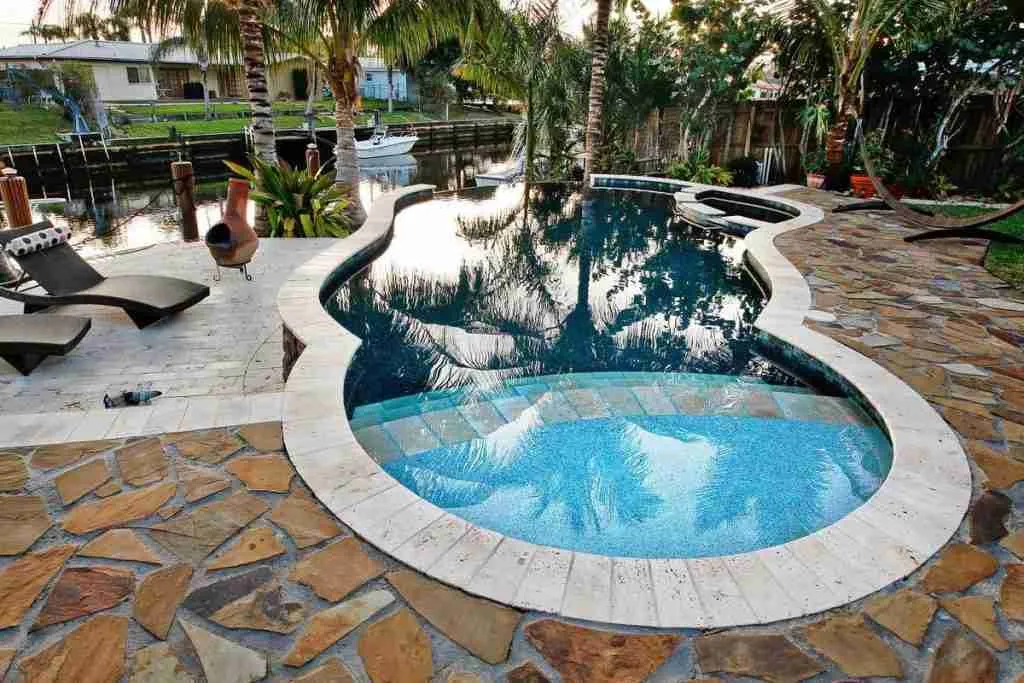
There is a distinct moment of frustration that occurs when you step out of a beautifully heated spa—only to feel a surface underfoot that lacks texture, holds too much heat, or feels precariously slick.
The water in your custom spa is immaculate. The midday weather in West Palm Beach is absolutely flawless. Yet, if the surrounding deck material feels like an afterthought, the entire wellness experience loses its magic. A true luxury spa requires a surrounding foundation that matches the architectural sophistication of your estate while standing up to water, heat, and foot traffic.
At RPD Custom Pools, we regularly consult with South Florida homeowners facing this architectural crossroad: choosing between premium travertine and architectural-grade marble for their spa surrounds. Both materials elevate a property’s profile, but each interacts with our coastal environment, your bare feet, and your home’s aesthetic in completely different ways. Visit our Google Business Profile to see our past projects across South Florida.
This guide breaks down the true differences between travertine and marble decking, ensuring you select the perfect stone for your high-end backyard retreat.
Texture vs. Transcendence
The Anatomy of Travertine
Travertine is a form of terrestrial limestone deposited by geothermal hot springs over millennia. This specific process gives the stone its signature warm, earthy palette and a distinctive porous structure. These natural voids aren’t structural flaws; they are the exact reason unfilled, tumbled travertine excels at dissipating heat and providing natural traction in wet environments.
The Anatomy of Marble
Marble is a metamorphic rock born from limestone subjected to massive tectonic heat and pressure. This creates a dense, highly durable surface celebrated for its striking veining patterns. While indoor marble is polished to a mirror sheen, outdoor spa decking relies on specialized tactile finishes—like tumbled, brushed, or sandblasted techniques—to deliver safety without sacrificing its elite visual status.
Cost and Engineering Factors
Integrating a premium stone deck around a luxury spa demands an investment that accounts for quarry selection, safe surface fabrication, and layout mapping.
-
Sourcing and Rarity: True architectural marble often commands a higher price per square foot than travertine, driven by the exclusivity of white and silver-gray quarries prized by custom builders in Jupiter.
-
Surface Treatments: Transitioning dense marble into a safe, non-slip outdoor surface requires specialized factory finishes (such as bush-hammering or acid-washing) which add to the production timeline.
-
Meticulous Craftsmanship: Because marble features distinct, directional veining, installing it requires an expert eye to blend and balance the tiles seamlessly across the deck footprint.
Travertine represents a classic, highly reliable luxury baseline. Because it is naturally rich in friction and readily available in diverse sizing patterns, it requires less intensive factory processing to be completely pool- and spa-ready. View our local service updates for ideas on your own backyard transformation.
Performance in the Florida Climate
A luxury spa deck must look spectacular while enduring intense UV exposure, pool chemistry, and heavy rainstorms.
Travertine Performance: The Cool Competitor
Travertine is the undisputed champion of thermal comfort. Thanks to its aerated, porous composition, it resists storing thermal energy, remaining remarkably comfortable to walk on even during peak summer afternoons. Furthermore, its natural pores absorb moisture quickly, drastically reducing standing puddles around your spa steps.
Marble Performance: The Dense Defender
Marble’s incredible density gives it an edge in structural strength. It shrugs off heavy patio furniture and resists scratching beautifully. While light-colored marble reflects sunlight efficiently, it is denser than travertine and will feel warmer underfoot at midday. Additionally, while its tight crystalline structure prevents water logging, it still requires proper sealing to protect against organic stains and chemical etching.
Material Comparison Matrix
| Property | Premium Travertine | Textured Architectural Marble |
| Aesthetic Vibe | Warm, organic, Mediterranean resort | Ultra-sleek, modern estate elegance |
| Thermal Comfort | Exceptionally cool underfoot in direct sun | Stays comfortable in lighter shades; warmer at midday |
| Slip Resistance | Naturally high due to porous, unfilled composition | High, but relies entirely on specialized textured finishes |
| Stain & Etch Resistance | Moderate (porous; requires prompt cleaning & sealing) | Moderate (dense, but highly sensitive to acids) |
| Design Versatility | Pairs beautifully with lush, tropical landscapes | Complements minimalist and sharp geometric architecture |
Deciding Which Stone Belongs in Your Oasis
When to Choose Travertine
Travertine is the ideal choice if your wellness space leans toward an organic, tropical, or European villa aesthetic. If your spa sits in a completely exposed, sun-drenched section of Palm Beach Gardens and your absolute priority is maximum barefoot comfort and a natural, high-friction texture, travertine delivers unmatched performance.
When to Choose Marble
Marble is the clear choice if your home features clean, minimalist, or ultra-modern architecture. If your luxury spa incorporates crisp geometric lines, glass mosaic tiles, or high-contrast dark coping accents, premium exterior marble provides an elite, editorial-worthy finish that ordinary paving options simply cannot replicate.
The RPD Customs Approach
We do not just order crates of stone and lay them down blindly. Our design process begins with a detailed on-site assessment of your yard’s sun orientation. We curate stone samples that complement your existing home, create high-fidelity 3D renderings to show you how the stone looks under sunlight, and hand-select stone lots to guarantee color consistency.
If you’re ready to transform your outdoor space, reach out to our custom pool builders in West Palm Beach to schedule your complimentary design consultation.
Frequently Asked Questions
1. Can I use polished marble for my outdoor spa deck?
Absolutely not. Polished marble becomes incredibly slippery when wet and poses a serious safety hazard. For all wet areas, spas, and pool surrounds, we exclusively use tumbled, brushed, or sandblasted marble to ensure a safe, slip-resistant surface.
2. Do the natural holes in travertine weaken the deck over time?
No. First-grade, premium travertine is highly durable and has been used in architecture for thousands of years. For spa surrounds where bare feet frequently walk, we recommend tumbled, unfilled travertine—the edges of the pores are softened naturally, providing excellent grip without trapping excessive dirt.
3. How often do these natural stone decks need to be sealed?
To protect your investment from South Florida’s intense humidity, frequent rain, and spa chemicals, we recommend applying a professional-grade penetrating sealer every 2 to 3 years. This keeps the stone looking vibrant and prevents deep organic staining or chlorine etching.
4. Will salt or chlorine water damage marble decking?
As long as the marble is properly sealed and your spa’s water chemistry is kept balanced, modern pool water will not damage the stone. Standard preventative sealing ensures that splashing water evaporates cleanly without leaving mineral rings or dulling the stone’s face.
5. Which stone holds up better against heavy patio furniture?
Marble holds a slight advantage here due to its higher geological density and metamorphic structural strength. It exhibits superior resistance to indentations, chips, or surface scratches from heavy wrought-iron, teak, or modern metal lounge seating frequently repositioned around the spa.